
Over the past three years, we shaped Europe’s quantum story through a series of campaigns that connected complex science to real-world relevance, brought researchers and policymakers into the same conversation, and helped the public understand why quantum matters.
Working with the Quantum Flagship, we helped to turn major scientific and policy milestones into stories that travelled across continents. Each campaign had a different audience and a different challenge, but together they built a coherent narrative: Europe is a global leader in quantum science and technology. What follows is a closer look at the campaigns for the Quantum Flagship that defined this work. These stories (which spanned strategic vision, policy moments, hardware breakthroughs, climate resilience missions and public opinion insights) show how Europe’s quantum ecosystem came to life in the media and how communication helped shape global understanding of Europe’s ambitions.
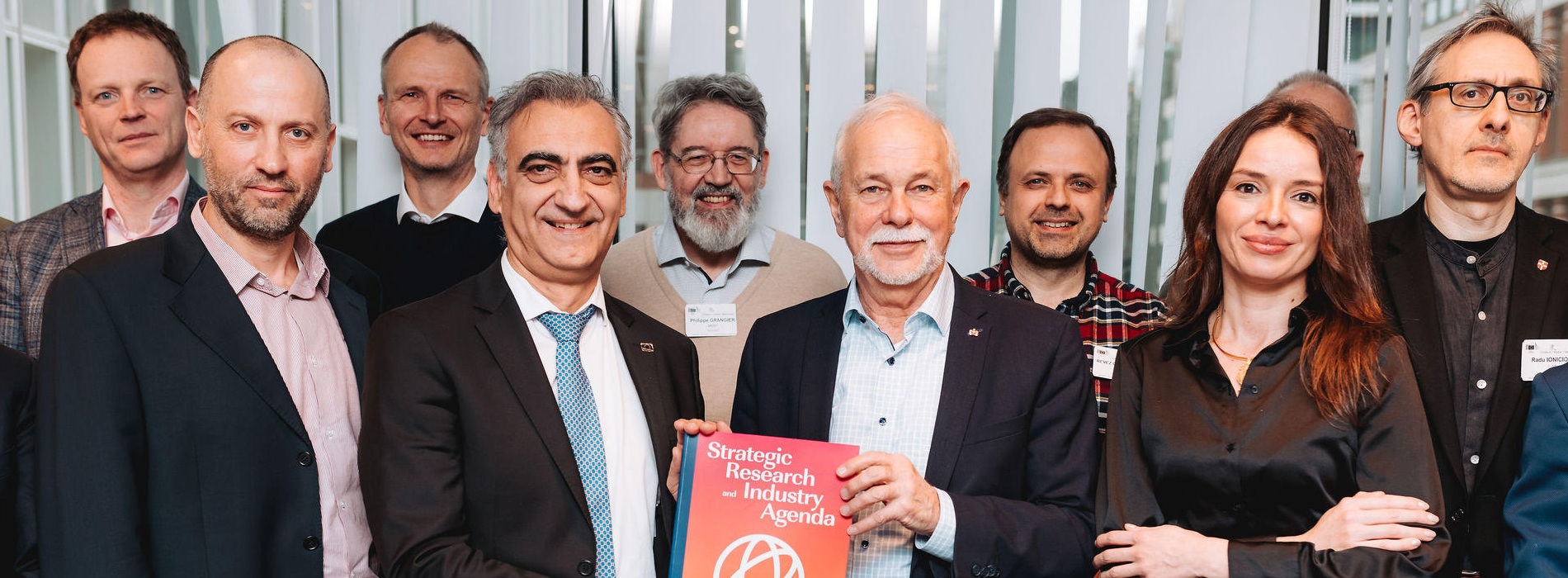
SRIA 2030 marked the moment Europe’s “Quantum Valley” began to form. The idea drew directly from Silicon Valley, the world’s most famous innovation hub, known for its concentration of talent, investment, world-leading companies and a culture that turns research into industry-shaping breakthroughs. By invoking that comparison, the campaign positioned Europe as a region capable of building its own globally competitive quantum innovation engine. We helped turn a dense strategic document into a clear, forward-looking vision for Europe’s quantum future, and the idea of Europe emerging as a rival to Silicon Valley resonated strongly. Twenty-one outlets covered the story, giving the quantum community a shared reference point. Journalists picked up on themes of sovereignty, long-term investment and Europe’s growing research strength, allowing the story to travel well beyond the usual deep-tech press. For many readers, this was the first time Europe’s quantum ambitions appeared as a coordinated, continent-wide effort rather than a collection of isolated projects. It was a shift that became the foundation for every campaign that followed.

The Belgian Presidency Event, centred on the European Quantum Pact, generated a scale of response the Flagship had never seen before. The Pact itself was a political commitment by EU Member States to work together on quantum technologies with the same ambition, coordination and long?term investment that made Silicon Valley the world’s most powerful innovation engine. In practical terms, it signalled that Europe was no longer treating quantum as a scattered collection of national projects, but as a shared strategic priority. The Pact outlined where countries would pool expertise, align roadmaps, and build secure, sovereign quantum capabilities that Europe could rely on for decades to come. For policymakers and industry alike, it was a reassurance that Europe intended to stay competitive, protect its digital infrastructure, and avoid dependence on foreign quantum technologies at a time when global cyber risks are accelerating. Coverage appeared in forty?eight outlets across Europe, Asia and North America, with a combined potential reach of 167 million people and an estimated readership of nearly 4.8 million. What stood out was the breadth: national news, policy media, technology platforms and specialist quantum press all picked up the story. For many audiences, this was the first time quantum policy broke through as headline news rather than a niche research update, setting a new benchmark for how far a European quantum story could travel.
The International Year of Quantum Science & Technology (IYQ 2025) offered a rare moment when quantum moved out of research labs and policy circles and into mainstream public conversation. The campaign centred on the United Nations’ decision to designate 2025 as a global year of celebration and awareness?raising for quantum science. While the announcement came from the UN, the Quantum Flagship played a major role in amplifying it across Europe and internationally, explaining why quantum deserved a global spotlight — its scientific heritage, its growing role in technology and industry, and its importance for education and future skills. Coverage appeared in The Hindu, Big Think, MUY Interesante, Physics World and more, reaching over sixty?four million people. With thirty?seven articles, the story travelled far beyond the usual science and policy circles, especially in India, Europe and North America. For many readers, this was the first time quantum science appeared as part of a broader cultural and educational moment, helping set the stage for public?facing initiatives throughout 2025.

ONCHIPS delivered one of Europe’s most significant hardware breakthroughs: the continent’s first germanium–silicon quantum chip, integrating electronics and photonics on a single platform. It addressed one of quantum computing’s biggest bottlenecks: how to build scalable, manufacturable chips using semiconductor-industry processes rather than bespoke lab setups. The story had immediate international appeal. The campaign generated thirty articles across mainstream tech, semiconductor, photonics and quantum media, reaching a potential audience of 578.8 million people and an estimated 7.9 million readers. It quickly became a reference point in discussions about Europe’s semiconductor capabilities and its push for technological sovereignty, showing that Europe is not just participating in the hardware race but shaping it.
SPINUS explored one of the most intriguing directions in quantum computing: diamond-based spin qubits capable of operating at or near room temperature. Instead of relying on extreme cooling, the project focused on materials such as diamond and silicon carbide to create qubits that are more practical, energy-efficient and scalable. The idea alone caught editors’ attention, offering a glimpse of quantum computing that felt closer to real-world deployment. The campaign generated ten articles and achieved extraordinary visibility thanks to a major MSN feature, pushing the potential reach to 615.9 million people and an estimated readership of 18.5 million. SPINUS became one of the Flagship’s most impactful hardware stories, helping a wide audience understand why diamond-based qubits matter and why Europe is investing in them.
CARIOQA-PMP brought quantum sensing into the climate conversation. The mission set out to build one of Europe’s first quantum sensors for space — a cold-atom instrument designed to measure minute variations in Earth’s gravity field with far greater precision than today’s satellites. That level of sensitivity has real consequences: it can help track ice loss, sea level rise, groundwater depletion and other climate-driven changes that are currently difficult to monitor. The campaign generated twenty articles with a potential reach of 10.3 million people and an estimated readership of more than 686,000, appearing across mainstream news, electronics and photonics media, aerospace outlets and specialist quantum press. It showed that quantum sensing is not a distant research topic but a tool that could help Europe understand and respond to environmental change.

HYPERSPACE set out to do something that instantly captured attention: send quantum-secured data across the Atlantic, linking Europe and Canada via next-generation communication channels designed to withstand future cyber threats. The campaign drew parallels between Guglielmo Marconi, who was just 27 years old when he did something that changed the world. The Italian-Irish inventor, after years of toiling away at his idea, sailed to Newfoundland in Canada to receive the world’s first radio transmission from across the Atlantic – an ‘S’ in Morse code, from Cornwall in 1901. The following year, Marconi sent the first wireless signal back to England. His work earned him a Nobel Prize and ushered in a new age of worldwide electronic communication. Our campaign showed that 120 years later, scientists were attempting to send another signal across the Atlantic. But this time, with a quantum beam. The media response reflected that strength, with fourteen articles across cybersecurity, defence, networking, IT infrastructure and quantum outlets, reaching a potential audience of 5.2 million people and an estimated 156,000 readers. It resonated especially well with operators, analysts and decision-makers responsible for securing real-world systems.
The YouGov survey tackled a question rarely asked in quantum: what do ordinary people actually think about this technology? Using nationally representative polling in France and Germany, the project explored public attitudes toward quantum science, studying the real-world issues people care about, from healthcare and climate action to energy security, cybersecurity and Europe’s technological future. The story travelled quickly, with twenty high-quality articles. It landed particularly strongly on Euronews, which ran multiple editions across Europe and Africa. For many outlets, this was the first time they could write about quantum through the lens of society rather than lab results, opening the door to a broader conversation about trust, awareness and Europe’s role in emerging technologies.
Matter PR is a global communications agency that specialises in science, technology, and engineering. Contact us if you would like to discuss a project or campaign.
Communicating Europe’s Quantum Story
Over the past three years, Matter PR has led an international media campaign to position Europe as a global leader in quantum technologies and strengthen engagement with industry, policymakers, and the media. We delivered 17 major campaigns, generating 257 articles in media outlets worldwide, reaching an estimated 40 million readers. Our work focused on advancements [...]
AI’s energy problem is out of control – this new tech fights back
AI is consuming electricity at a staggering rate, and scientists in Europe and South Korea believe they’ve found a way to curb the power drain. Their new research uses light-based chips to process data far more efficiently than today’s electronics, offering a potential lifeline as AI’s energy appetite spirals. Our team helped bring this story [...]
Media campaign puts €5M Photonics Talent Pipeline in global spotlight
We delivered a media campaign that placed Europe’s new €5M photonics education and training network firmly in the global conversation about technology, skills and industrial competitiveness. When the European Commission invested €5 million into a new pan-European education and training network for photonics, the challenge was to ensure that this investment in skills was heard [...]
Matter PR promotes transatlantic quantum internet
We were appointed to deliver an international media campaign for HYPERSPACE, the Horizon Europe and Canadian-backed quantum communications project aiming to build the foundations of a transatlantic quantum internet. The campaign was delivered on behalf of the EU’s Quantum Flagship, ensuring that the transatlantic project was positioned as part of Europe’s long-term strategy for quantum [...]
How to Make a Promotional Film
James Harrison's top tips for making a promotional film with impact and a sense of purpose Many corporate promotional films comprise not much more than a bunch of loosely-edited sequences with no sense of logic. Add poor quality sound, misjudged music, and an anodyne voice over, these badly executed videos lack any sense of purpose. [...]